How to Select PVC Resin for Pipes, Profiles and Cables
How do you choose PVC for pipes, profiles or cables?
PVC resin should be selected by the finished product, formulation and extrusion requirement. Rigid pipes and profiles generally begin with suspension PVC grades offering suitable molecular weight and fusion behaviour, while flexible cable applications require a complete compound design that includes plasticisers, stabilisers and performance additives.
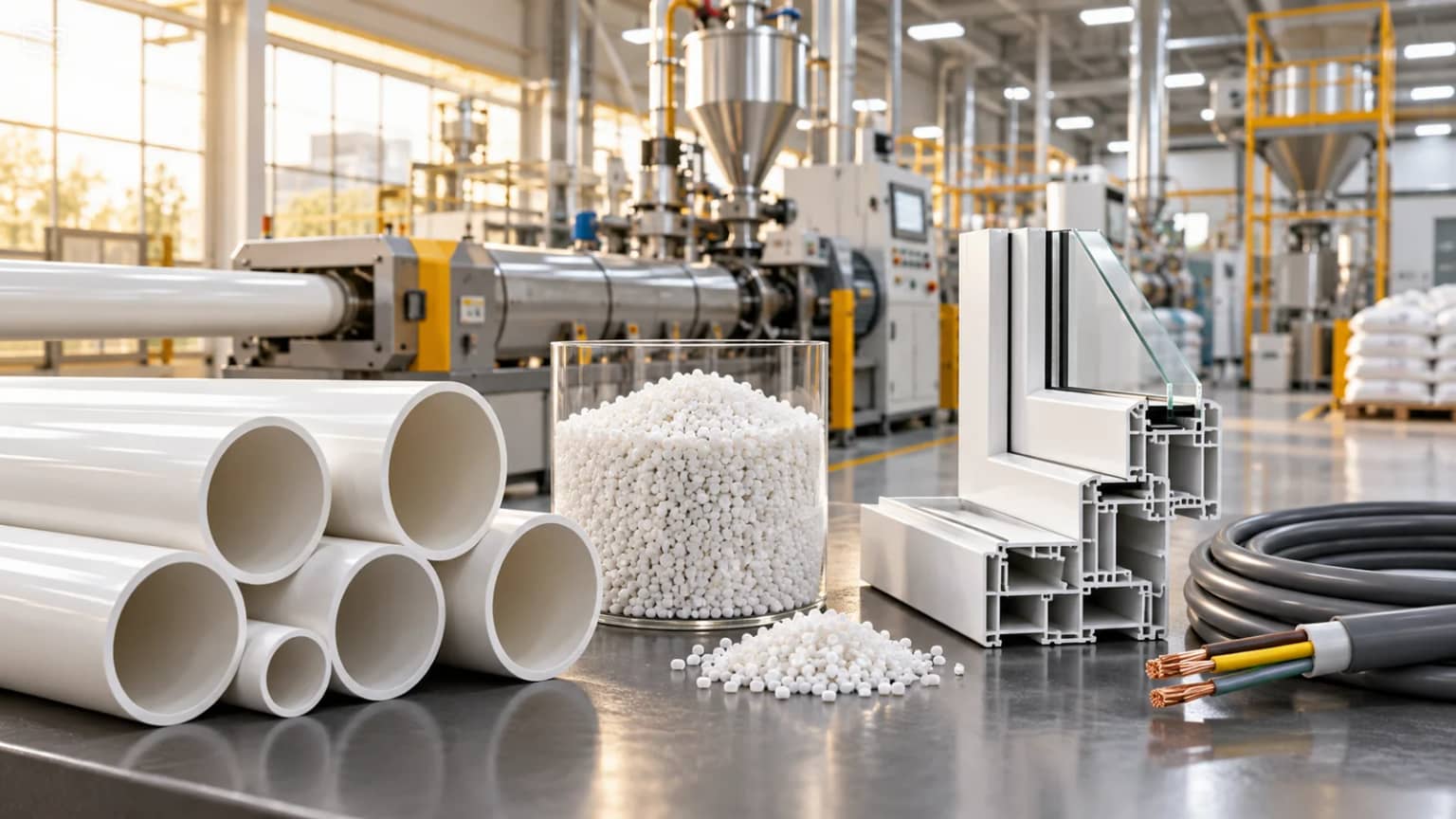
PVC is highly formulation-dependent. Resin choice is important, but additives, equipment and processing conditions ultimately determine finished-product performance.
Why formulation matters: supporting evidence
The European Council of Vinyl Manufacturers explains that PVC additives allow formulations to serve different uses, including pipes and cables. Its plasticisers overview explains their role in making PVC flexible. These references support separating rigid pipe/profile formulations from flexible cable compounds; they do not qualify a particular resin or finished product.
Before ordering, request the exact resin or compound TDS, the relevant formulation guidance and application-specific test evidence. Use our PVC supply page, TDS request service and masterbatch and compounding guide to prepare your enquiry. The UAE branch can coordinate commercial and documentation questions.
Quick application guide
| Application | Typical material direction | Key selection factors |
|---|---|---|
| Pressure and drainage pipe | Rigid suspension PVC | Molecular weight, fusion, impact, hydrostatic performance |
| Window and construction profiles | Rigid suspension PVC | Surface finish, dimensional stability, weathering, impact |
| Cable insulation | Plasticised PVC compound | Electrical properties, flexibility, temperature rating |
| Cable sheathing | Flexible PVC compound | Abrasion, flame performance, oil/weather resistance |
| Flexible hose and tubing | Plasticised PVC | Softness, clarity, migration and chemical resistance |
This is a starting framework. Standards, formulation and qualification testing govern final suitability.
What does PVC K-value mean?
K-value is commonly used as an indication of PVC molecular weight. Higher values are generally associated with higher molecular weight and different mechanical and processing characteristics. The preferred range depends on the application, formulation and equipment.
K-value should be reviewed alongside bulk density, porosity, volatile content, particle characteristics and thermal stability—not treated as a standalone buying specification.
What should you check when selecting PVC for pipes?
Pipe manufacturers must align resin and formulation with pipe type, diameter, pressure class, impact target and relevant standard. Fusion behaviour, processing stability and consistency are critical for steady extrusion and reliable long-term properties.
Key questions include:
- Is the pipe pressure-rated or non-pressure?
- Which national or international standard applies?
- What impact and hydrostatic performance must be demonstrated?
- Which stabiliser and processing-aid system will be used?
- Is potable-water approval required?
What matters when selecting PVC for profiles?
Window, door, conduit and construction profiles place emphasis on dimensional stability, surface quality, colour retention and weatherability. Impact modifiers, titanium dioxide, stabilisers and processing aids can be as important as the base resin.
Profile geometry and calibration also influence fusion and output, so trials should reflect the actual production line.
What matters when selecting PVC for cable applications?
Cable insulation and sheathing normally use flexible PVC compounds rather than neat resin. Formulators balance plasticiser type and level, thermal stabilisation, fillers, flame-retardant performance, electrical properties, flexibility and operating temperature.
The compound must be evaluated against the applicable cable specification. A formulation suitable for indoor low-voltage insulation may not suit outdoor, oil-resistant or flame-retardant sheathing.
What should you include in a PVC enquiry?
- Application: pipe, profile, insulation, sheathing or another finished product.
- Specification: applicable standard, service environment and target properties.
- Material: current grade or K-value, formulation type and required additives.
- Process: equipment, extrusion conditions and qualification requirements.
- Supply: monthly quantity, delivery destination and required date.
Frequently asked questions
What PVC grade is commonly used for pipes?
Suspension PVC is a common starting point for rigid pipe. The required molecular-weight range and formulation depend on the pipe standard, performance target and extrusion line.
Is the same PVC resin used for pipes and cables?
The base chemistry may be PVC, but the formulations are very different. Rigid pipe uses an unplasticised formulation, while flexible cable compounds normally contain plasticisers and application-specific additives.
Why is thermal stability important in PVC processing?
PVC has a limited processing window. Adequate stabilisation and controlled shear and temperature help prevent degradation, colour change and inconsistent product quality.
What information should a PVC buyer provide?
Provide the application, applicable standard, current resin or K-value, formulation type, process, target properties, monthly requirement and delivery destination.
Discuss PVC supply and grade selection
Multi Trade Group supports manufacturers with PVC resin and polymer sourcing, international logistics and application-focused coordination. Review available technical data sheets or contact our materials team with your specification and volume.