How Did Multi Trade Group Become the Middleman in the Global Trade of Polymers?
Multi Trade Group developed its role in global polymer trade by bringing together manufacturing experience, regional customer relationships, resin sourcing and physical distribution. Its history connects early plastics manufacturing in Pakistan with trade into West Africa and the establishment of a UAE base in 1996.
In this context, a middleman connects polymer producers with the businesses that turn resin into finished products. For Multi Trade Group, that role includes helping customers discuss material requirements, coordinate supply and arrange delivery across markets.
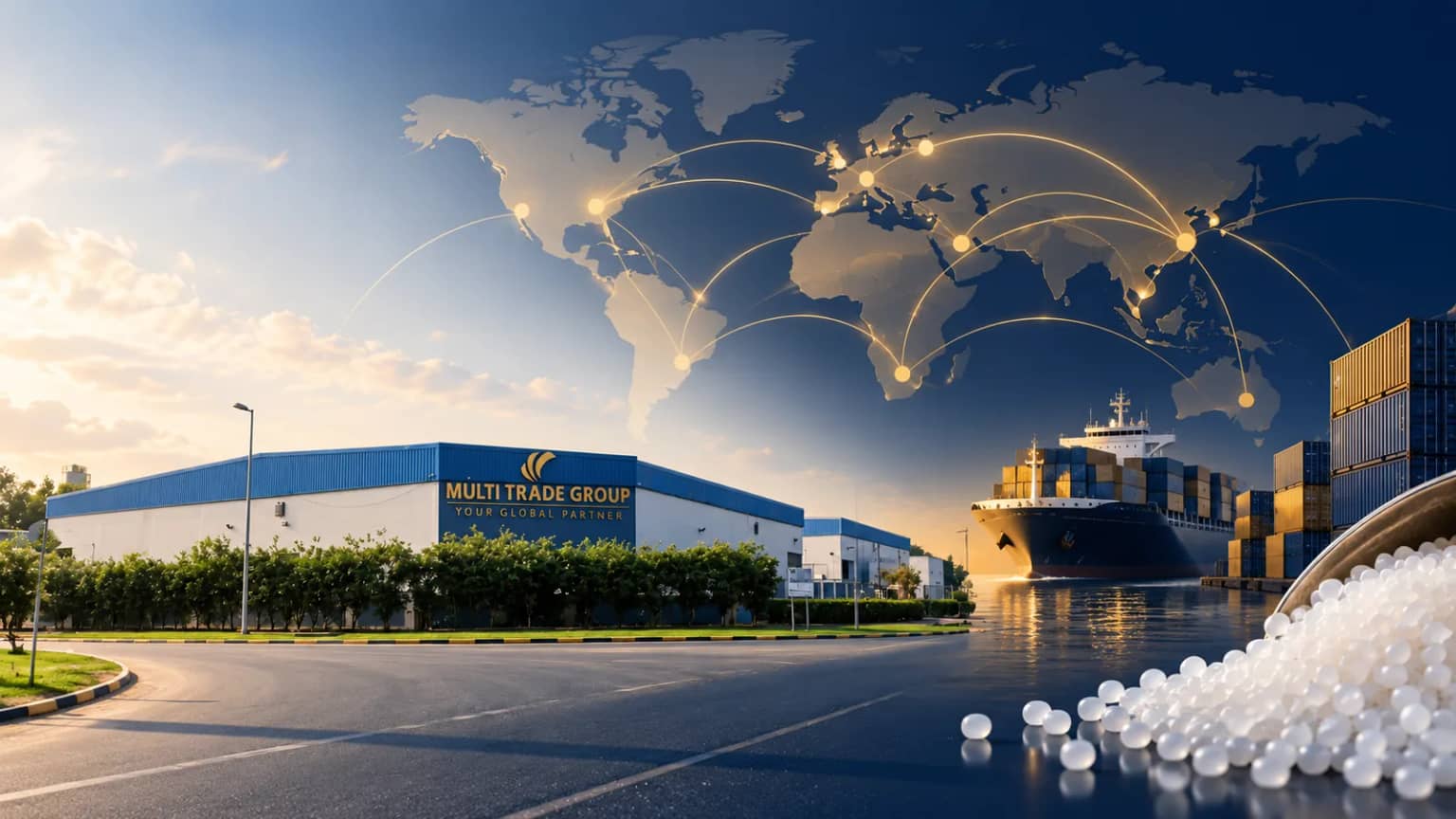
Editorial illustration based on an original photograph of Multi Trade Group's UAE facility, combined with conceptual shipping, polymer and global trade imagery. Routes and shipping elements are illustrative.
Where did the business begin?
The group's published company history traces its roots to the late Mr. Iftekhar Ahmad Butt and an injection moulding factory established in Pakistan in 1973 to produce beverage caps. Those manufacturing roots came before the formal founding of Multi Trade Group.
A plastics manufacturer works with the practical consequences of material selection: how a resin processes, whether a finished part meets its requirements and whether material arrives in time for production. That background helps explain the connection between the group's manufacturing origins and its later focus on supplying converters.
The next milestones moved the business closer to international distribution. The company timeline records expansion to the United Kingdom in 1983, focused on trade with West Africa, followed by an office and warehouse in Lagos, Nigeria, in 1984 for local polymer distribution. In 1996, Multi Trade Group was formally founded in the Sharjah Free Zone in the UAE.
These milestones show a progression from making plastic products to trading across borders and establishing a local distribution presence.
Why was a UAE base important to its development?
The group's Sharjah headquarters coordinates international polymer trading, supplier relationships and regional distribution. Its published address is M4-18, SAIF Zone, P.O. Box 7852, Sharjah, United Arab Emirates.
A central commercial team can connect enquiries from different markets with sourcing and shipment discussions. A buyer needs a specific grade, quantity and delivery date; a producer needs clear requirements and an agreed commercial arrangement. Coordinating those details is a substantial part of a trading partner's work.
Multi Trade Group's UAE services include global sourcing, regional stock coordination, commercial and technical support, and international logistics and documentation. Together, these activities connect the purchase discussion with the movement of material.
How did regional distribution develop into a wider network?
Following its UAE establishment, the group's published timeline records further manufacturing and regional expansion. Multi Industries was established in 2001 to manufacture food packaging, PVC pipes and construction products. In the 2010s, the business added offices in Kenya and Serbia and expanded into East Africa, Southeast Asia and GCC markets.
Later developments included a broader international office presence and the establishment of Multi Power Logistics. The company also describes a US office supporting North American polymer sourcing and expansion into Latin America.
The significance for buyers is the combination of international sourcing and regional contact points. Customers can discuss their requirements with a team familiar with the destination market while drawing on the group's wider supply network. The branch directory identifies the published locations and their services.
What does a polymer trading partner contribute to an order?
The value of an intermediary becomes clearer when looking at the decisions needed before a shipment can move:
- Define the material requirement. Establish the polymer family, producer grade, processing method and intended application.
- Check the supply option. Confirm the proposed producer, quantity, dispatch location and expected lead time.
- Coordinate documentation. Identify the technical data and shipment documents needed for the order.
- Agree delivery details. Set out the destination, schedule and responsibilities in the commercial offer.
- Support repeat purchasing. Discuss forecast demand and replenishment needs with the customer.
For example, a film converter asking for polyethylene still needs to specify the grade and production requirements. A useful supply discussion turns that broad enquiry into an offer the purchasing and production teams can evaluate. Our plastic resin procurement checklist explains how to prepare that brief.
How do warehousing and a broader product portfolio support this role?
Warehousing links sourcing decisions with physical distribution. It provides a place to hold and coordinate material before onward delivery, while stock allocation and shipment scheduling help connect an order with a customer's production plan. Our UAE polymer warehousing article describes this part of the operation.
The group's product portfolio spans polyethylene, polypropylene, PVC, PET and other polymers, alongside masterbatches and related materials. Its MultiTec business adds a focus on masterbatch and compounding requirements.
This breadth gives customers several material requirements to discuss with the group. Each enquiry still needs confirmation of the exact grade, availability, quantity and delivery terms; a portfolio listing is not a promise of immediate stock at every location.
Frequently asked questions
When was Multi Trade Group founded?
Multi Trade Group's published timeline gives 1996 as its formal founding in Sharjah, UAE. It separately traces the business's manufacturing roots to Pakistan in 1973.
Why do manufacturers work with a polymer intermediary?
An intermediary can help coordinate sourcing, commercial terms, documentation and delivery. Its usefulness depends on how well the proposed supply arrangement meets the manufacturer's material and production requirements.
Is Multi Trade Group only a trading business?
The group's published history and portfolio also describe manufacturing, warehousing, logistics, masterbatch and compounding activities. The relevant company and service should be confirmed for each enquiry.
Can buyers request a particular producer grade?
Yes. Include the producer and grade code, required volume, application and destination in your enquiry. The team can then check supply options and confirm the terms of a specific offer.
Discuss your polymer sourcing requirements
Multi Trade Group's development reflects the combination of manufacturing roots, regional distribution and international supply coordination. Those capabilities define its role between resin producers and the businesses that use their materials.
Contact Multi Trade Group, email sales@multitradegroup.com, or call +971 6 557 0135. Share your grade, quantity and delivery destination to begin a focused sourcing discussion.
Company milestones are drawn from Multi Trade Group's published history; UAE services and contact information were checked against its UAE location page on 11 October 2026.