PP vs HDPE for Rigid Packaging: Which Polymer Should You Choose?
Should you choose PP or HDPE for rigid packaging?
Choose polypropylene (PP) when heat resistance, living-hinge performance or a lower-density rigid part is important. Choose high-density polyethylene (HDPE) when toughness, moisture resistance, chemical resistance and durable bottle performance are the priorities. The final choice depends on the grade, package design, process and product being packed.
What evidence should a packaging buyer request?
Ask for the exact grade's current TDS, processing guidance and applicable end-use declarations. Compare impact results at the intended service temperature, stiffness using the same test method, and package-level drop or stacking trials. A resin-family comparison cannot establish that a finished package meets its specification.
LyondellBasell describes PP impact copolymers as having enhanced impact resistance and lists packaging among their uses. This supports distinguishing PP grades rather than treating all polypropylene as one material. This reference does not imply that a particular grade is stocked or approved for your application.
Compare our polypropylene and HDPE sourcing services, request a grade-specific TDS, or contact the UAE team.
PP vs HDPE at a glance
| Selection factor | Polypropylene (PP) | HDPE |
|---|---|---|
| Stiffness | Typically high | Good, grade-dependent |
| Impact at low temperature | Grade-dependent | Often a strong choice |
| Heat resistance | Generally higher | Generally lower than PP |
| Moisture resistance | Very good | Excellent |
| Chemical resistance | Very good | Excellent for many applications |
| Common processes | Injection moulding, thermoforming, extrusion | Blow moulding, injection moulding, extrusion |
| Typical packaging | Food tubs, caps, closures, hinged packs | Bottles, jerrycans, drums, crates |
Values vary by homopolymer, copolymer, molecular design and additives. Compare candidate technical data sheets rather than relying only on the polymer name.
When is PP better for rigid packaging?
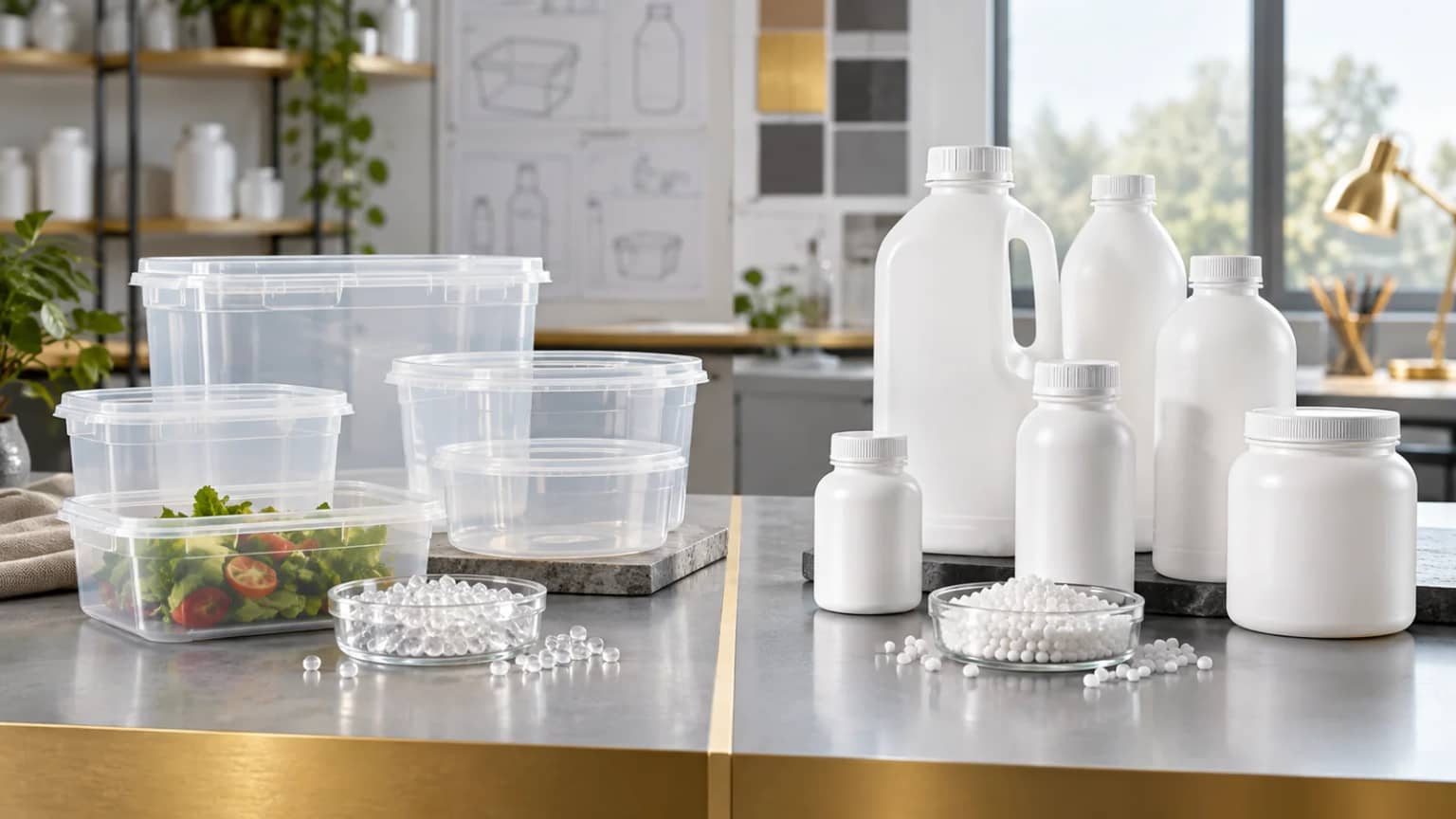
PP is frequently selected for injection-moulded food containers, caps, closures and packages that may encounter elevated temperatures. It can offer strong stiffness-to-weight performance and is widely associated with integral or living hinges.
Random copolymer PP may be evaluated where improved clarity is important, while impact copolymer PP may be considered when greater toughness is needed.
When is HDPE better for rigid packaging?
HDPE is a common choice for blow-moulded household, personal-care, food and industrial bottles. Its toughness, moisture resistance and chemical resistance support demanding packaging formats, including larger containers and transport packaging.
Environmental stress-crack resistance, density, melt strength and impact performance are important grade-level considerations for bottles and containers.
What should you check before qualifying a packaging grade?
Start with the package geometry and manufacturing process. Blow-moulded bottles usually require grades engineered for melt strength and parison control.
Thin-wall injection moulding may require flow behaviour that fills the cavity quickly without compromising part performance.
Ask the following before qualification:
- Is the package injection moulded, blow moulded or thermoformed?
- What wall thickness, cycle time and output are required?
- Will the pack be hot-filled, frozen, stacked or repeatedly opened?
- What product will contact the package?
- Which food-contact or market approvals are required?
- What quantity, delivery destination and required date should the quotation cover?
Frequently asked questions
Is PP stronger than HDPE?
Neither is universally stronger. PP is typically stiffer and offers better heat resistance, while HDPE often provides excellent toughness and chemical resistance. Grade and test condition determine the actual result.
Is PP or HDPE better for food containers?
Both can be suitable when the specific grade has the required food-contact status. PP is often considered for hot-fill or microwave-adjacent uses; HDPE is common for bottles and robust containers.
Which material is easier to recycle?
Both PP and HDPE have established recycling streams in many markets, but collection and processing infrastructure varies by region. Package design, labels, closures, colour and contamination influence recyclability.
Can PP and HDPE use the same mould?
Not automatically. Their shrinkage, flow, cooling and processing temperatures differ. A tooling and process review is required before changing resin families.
Source PP and HDPE with technical context
Multi Trade Group supplies polypropylene and polyethylene materials for converters across packaging and industrial markets. Share your package design, process and volume so our team can help identify an appropriate starting grade.